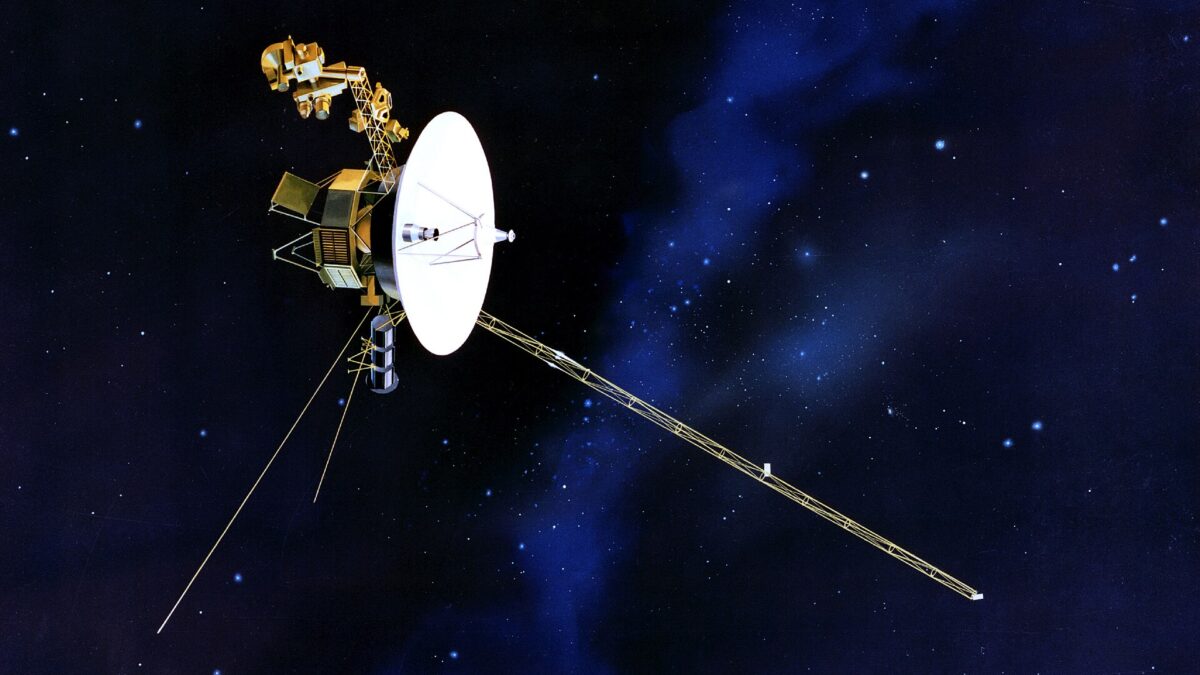
NASA’s Voyager 1 became the first human-made object to sit one light-day from Earth on Wednesday, Nov. 18. That’s the distance light covers in 24 hours, roughly 16.1 billion miles (25.9 billion kilometers).
NASA put the crossing at about 2:16 a.m. PST, according to IFLScience, which noted the exact moment could shift slightly. NASA’s own Night Sky Network notes said the Deep Space Network’s antenna in Canberra, Australia, had already tracked the probe at 25.8 billion kilometers in late October.
What a light-day means for the people flying it
Every message to Voyager 1 now takes 24 hours to arrive. The reply takes another 24. So when engineers at NASA’s Jet Propulsion Laboratory in Pasadena, California, send a command, they wait two days to learn whether it worked.
That lag isn’t academic. Controllers briefly lost contact with the spacecraft in October, and the cause still isn’t known, the Associated Press reported. The team sends commands about once a week.
“It’s a national treasure,” project manager Suzanne Dodd told the AP.
Running on what’s left
Voyager 1 launched in 1977, two weeks after its twin, Voyager 2. It crossed into interstellar space in 2012, and Voyager 2 followed in 2018.
Both run on plutonium power sources that lose output every year. Most instruments, including the cameras, have been switched off to save power, and the team finished another round of power-saving changes in September. IFLScience reports engineers are planning a further intervention to extend both missions, though NASA hasn’t detailed it.
Putting the distance in perspective
The probes travel about 38,000 mph. A little arithmetic shows how small one light-day really is on a cosmic scale:
- One light-day: 49 years of travel for Voyager 1.
- One light-year: about 365 times farther. At its current speed, Voyager 1 would need roughly 17,700 years to get there.
- Nearest star system (Alpha Centauri, about 4.2 light-years): on the order of 75,000 years at that pace, and Voyager isn’t headed that way.
Voyager 2 won’t reach a light-day until 2035.
When the power finally runs out, both probes will keep drifting with their golden records aboard. Voyager project scientist Linda Spilker called them “our silent ambassadors.”